
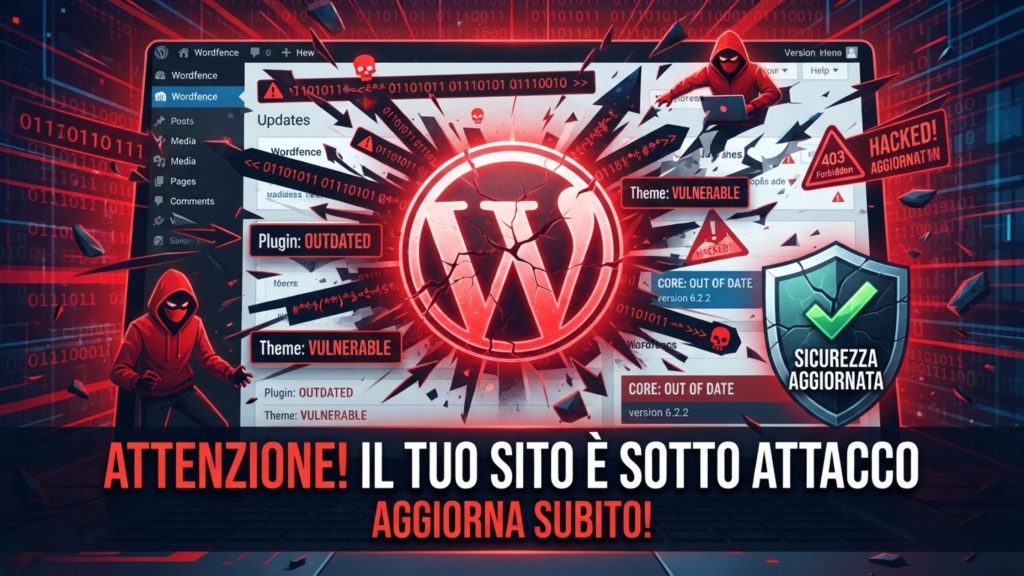
In recent days, the cybersecurity world has raised an important alert concerning WordPress, the platform behind a large percentage of websites worldwide.
A critical security issue, known as WP2Shell, has been analyzed by security researchers. Under certain conditions, it could allow attackers to take control of a website without knowing usernames and passwords and without relying on vulnerable plugins.
The vulnerability affects the core of WordPress itself (the software engine that powers the platform), which is why it has attracted significant attention from the cybersecurity community.
What does this mean in simple terms?
Imagine having a perfectly secure door, but the manufacturer discovers a flaw in the lock.
It does not matter how strong the door is: if the weakness exists, someone may find a way to open it.
This is what happens with software vulnerabilities.
Security researchers have identified weaknesses that, when combined, can allow an attacker to execute code directly on the server and potentially compromise the entire website.
Who is really at risk?
The good news is that not every WordPress website is vulnerable.
The issue mainly affects websites running outdated versions of WordPress or those that are not properly maintained.
Websites that are regularly updated and managed by experienced professionals have significantly reduced their exposure to these types of attacks.
What could a hacker do with a compromised website?
If a vulnerable website is breached, an attacker could:
- modify website content;
- install malware;
- steal sensitive information;
- create hidden administrator accounts;
- use the website to send spam or attack other systems.
For this reason, cybersecurity experts recommend taking action quickly and ensuring that websites are properly maintained.
How can you protect your website?
The rule is simple:
- rely on professionals for website security management;
- always update WordPress to the latest available version;
- keep plugins and themes updated;
- perform regular backups;
- use strong passwords and enable two-factor authentication whenever possible;
- regularly monitor the website for suspicious activity.
“My website is small… nobody will attack me.”
I know… this is probably what you are thinking right now.
And that is exactly the problem.
Your website is often not the final target.
Modern cyber attacks are highly automated and are constantly scanning thousands of websites looking for weaknesses.
A small business website can become a tool used by attackers without the owner’s knowledge.
Your website could be transformed into part of a network of compromised servers, also known as a botnet, used to launch larger attacks.
And you may not notice anything until it is too late:
- your website becomes unusually slow;
- your hosting provider suspends the account because of suspicious activity;
- your domain is blacklisted;
- your emails stop reaching customers because your address is considered unsafe.
Another common scenario is the abuse of your domain to send thousands of phishing emails.
The result?
Your company name and online reputation can be damaged, and your legitimate emails may start ending up in spam folders.
A warning for businesses and professionals
Many companies still consider their website just an online brochure.
Today, that is no longer the case.
A website is a real business tool that represents your company 24 hours a day.
Just like you update your computer or smartphone to protect yourself from security risks, your website also requires continuous maintenance.
Ignoring updates and security checks increases the risk of:
- reputational damage;
- data loss;
- website downtime;
- financial consequences.
Security is not only a concern for large companies
Cybersecurity does not concern only banks, governments, or large corporations.
A professional website, an online store, a local business website, or an association website can also become a target.
The important question is not:
“Will someone attack my website?”
The better question is:
“If it happens tomorrow, is my website ready to defend itself?”
If you are not sure whether your WordPress website is properly updated and protected, contact us.
A security check today can prevent much more expensive problems tomorrow.